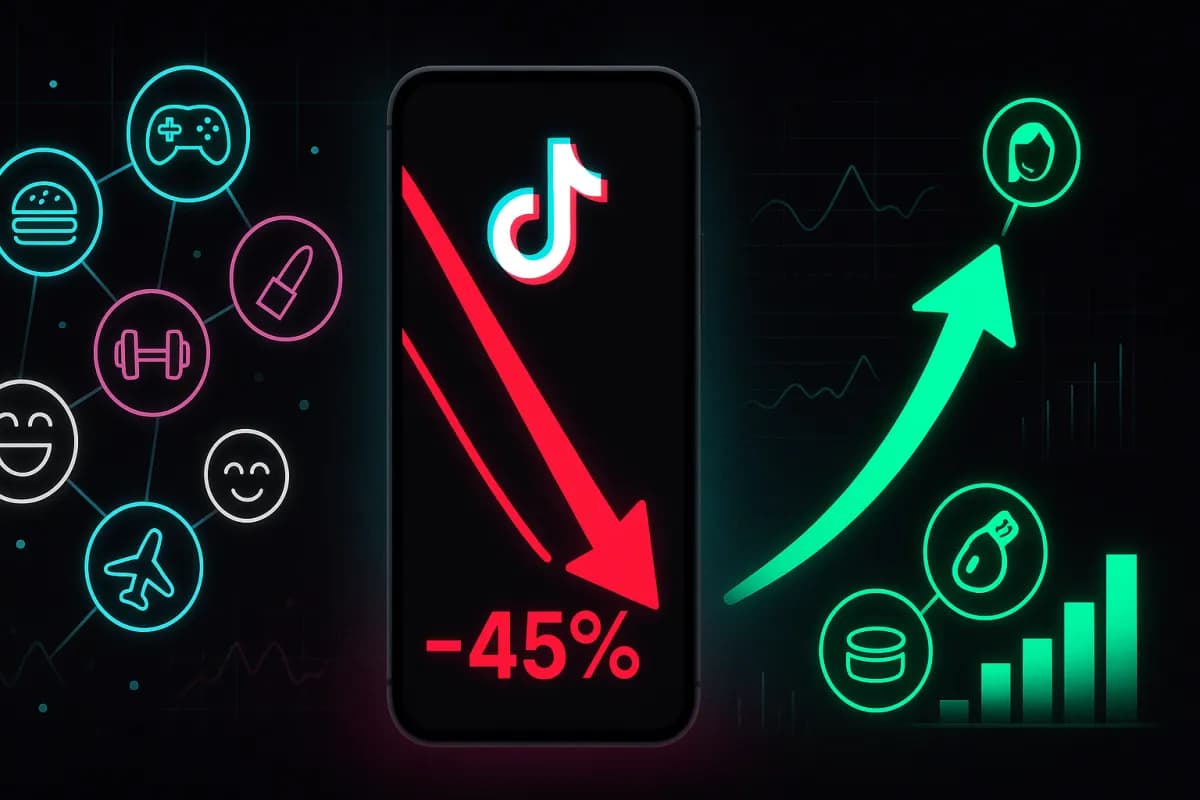
If your TikTok views have been stagnating or collapsing since spring 2026, you're not alone — and it's probably not a coincidence. According to Socialync's analysis of the algorithmic data leaked in May 2026, the platform now applies a massive penalty of -45% average reach to accounts that post on more than three unrelated topics. For the first time, TikTok is no longer the opportunistic virality machine it used to be: it has become a topical authority engine, where the algorithm constantly tries to understand "what this account is about" so it can match the account to coherent interest bubbles.
The stakes are even more brutal because the same Socialync analysis reveals other numbers that completely redraw the playing field. The completion threshold required to have a shot at going viral has jumped from 50% to 70%+ in 2026. A one-off viral post is now worth only a quarter of what it was worth in 2023, while a steady weekly cadence is valued four times more. And per the same source, the gap between a "casual" creator (5 to 10 active weeks) and a "consistent" creator (20+ active weeks) reaches a growth multiplier of ×5.3 — not +50%, but 5.3 times more.
This article breaks down for English-speaking creators: the exact mechanics of the cross-niche penalty, the famous "30-day rule" for rebuilding topical authority, the new 70% completion bar, the shadowban risk tied to over-posting, the impact of a week of silence, and a 7-step roadmap to align your content strategy with the 2026 algorithm.
The cross-niche penalty: what the leak says
The core data point is simple to state and devastating to observe. According to Truescho's analysis, which cross-references Socialync's data with the field observations of hundreds of creators, single-niche accounts enjoy "normal" reach as calibrated by the algorithm. Accounts that post across two adjacent niches (for example "fitness" and "nutrition") don't suffer a meaningful penalty. But as soon as an account crosses three or more topics without apparent coherence (for example "food + travel + gaming"), reach drops by 45% on average.
The mechanism is explicit on TikTok's side: the algorithm builds a "category" vector for each account, which then guides matching to audience bubbles. The more diffuse the vector, the less confident the matching, and the more the algo deprioritizes the content — not because it's bad, but because it becomes unable to predict who to show it to. This logic is confirmed by posteverywhere's analysis of 2026 ranking signals: topical consistency is now the #2 weighting factor after video completion, ahead of likes, shares, and comments.
Concretely, for an English-speaking creator who was doing "a bit of everything" until now (daily vlog, recipes, product tests, mood posts), the verdict is final: these hybrid accounts were forgiven by the 2023-2024 algorithm thanks to a "creator-first" logic. In 2026, TikTok has switched to a "content-first niche-pure" logic, and those same accounts see their reach collapse with no change in content quality.
The 30-day rule (and the 60-90 window)
On social media, you often hear: "you need to be patient." The 30-day rule makes that advice quantifiable. According to Socialync's data, the TikTok algorithm needs at least 30 days of coherent topical signals to build confidence in an account's category. Ideally, the window is 60 to 90 days before introducing an adjacent niche without risking a reset of the authority earned so far.
This means two things for a creator who wants to pivot or expand:
- Full reset (complete niche change): plan for a minimum of 30 days of posting 100% on the new theme before expecting reach to stabilize. During those 30 days, your views will often be disappointing (the algo is "learning").
- Adjacent extension (adding a closely-related subtopic): if your niche is "nutrition" and you want to add "fitness," ideally wait 60 to 90 days of pure coherence before introducing the new topic, then respect the 80/20 ratio (80% main niche, 20% adjacent niche) for another 30 days so the signal isn't muddied.
For creators who are already boosting their TikTok launch with targeted TikTok views, this 30-day rule matters even more: an external boost can accelerate algorithmic learning only if every boosted post is in the same niche. Boosting thematically scattered content makes the cross-niche penalty worse instead of solving it.
The 80/20 rule: the niche/adjacent cadence that works
The classic trap is believing you have to lock yourself into a single niche. That's wrong. According to Darkroom Agency, the fastest growth comes from accounts that post at least 80% in their main niche and reserve the remaining 20% for tightly related themes. This split delivers the "best of both worlds": preserved topical authority for algorithmic matching, and just enough variety to keep the existing audience engaged.
Concrete examples adapted to the US/UK market:
- A food creator (easy recipes) can integrate 20% "kitchen organization," "anti-waste grocery hauls," or "reviews of everyday products." Anything that stays within the "everyday kitchen life" perimeter. To avoid: travel, fashion, gaming, parenting.
- A tech creator (gadget reviews) can expand with 20% "productivity," "desk setup," or "useful apps." To avoid: food, lifestyle, fitness, comedy.
- A fashion creator (outfits of the day) can add 20% "beauty," "accessories," or "morning routines." To avoid: political news, gaming, code tutorials.
The 70% completion bar: the new viral standard
Before 2024, a 50% completion rate was often enough to trigger the viral spiral. In 2026, that threshold has exploded. According to Socialync, you now need 70%+ completion to have a serious shot at virality, and 80%+ for short videos (under 15 seconds) where every lost viewer counts.
This radically changes how to think about content. Three practical consequences:
1. Cut short or structure the promise. If an idea doesn't naturally hold up in 15 seconds with a hook that makes people want to stay until the end, it's better to either condense it ruthlessly or turn it into a medium format (30-60 seconds) with a clear payoff at the end of the video. The 60-90 second formats that die in the middle of the video are today's worst performers.
2. Mandatory hook in the first 2 seconds. According to OpusClip, 73% of the completion decision is made in the first 2 seconds in 2026. A "soft" intro with a logo, aesthetic transition, or fade-in music dramatically degrades average retention, and therefore total reach.
3. Loop the video. "Looping" consists of ending the video so it transitions naturally into its own beginning, encouraging viewers to watch it a second time. This technique artificially inflates watch time and completion. It's now standard among top US/UK creators.
The over-posting penalty: 5+ posts/day = shadowban risk
Counter-intuitive but documented: posting too much becomes a risk. According to Socialync, the sweet spot sits between 1 and 3 posts per day. Beyond 5 posts daily, the shadowban risk (silent reach reduction) climbs to 3-14 days. The logic: TikTok actively fights against "mass spam" accounts and AI content farms, and one of the primary markers is over-posting.
For English-speaking creators used to posting 1-2 times per day, this is excellent news. For those who "spray" 8 to 10 posts per day in spray-and-pray mode, it's an urgent stop sign. The cadence of 2 posts/day at fixed times + 1 weekly LIVE is currently the sweet spot universally recommended by TikTok-specialized agencies.
The silence penalty: 1 week without posting = 2 to 12 weeks of recovery
At the other extreme, silence is expensive. According to MSN's coverage of the 2026 algorithmic shift, after just one week of silence, a small account (under 10K followers) takes 2 to 6 weeks to recover its lost reach. A larger account (over 100K) takes 4 to 12 weeks. The bigger the account, the slower the algorithm is to "turn the distribution back on."
Concretely: if you take a week of vacation without posting, expect views to take a month to return to their usual level. The solution is to pre-schedule content during breaks (even a single Short per day is enough to maintain the activity signal). It has become the main argument for scheduling tools like Buffer, Hootsuite, and Later.
7-step roadmap to align your strategy with the 2026 algo
1. Audit your account: how many niches are you really posting in?
List your last 30 posts. Classify each one into a category (food, travel, tech, fashion, comedy, etc.). If you have more than 3 distinct categories, you're squarely inside the -45% penalty. Decide on one main niche and 1 adjacent niche, and stop the rest.
2. Freeze the secondary niches for 30 days
For the first 30 days, post 100% in your main niche. No exceptions, even if an "off-niche" idea seems brilliant. The goal is to re-calibrate TikTok's category vector on your account. Note your average views on day 0 and day 30: the difference will tell you the exact magnitude of the cross-niche damage you were suffering.
3. Optimize the first 2 seconds of every video
Visual hook + direct question + clear promise. No intro, no logo, no rising music. The hook is 2 seconds maximum. Test 3 different hooks on 3 similar videos to identify which ones boost your completion.
4. Adopt the 15-30 second format to target 80%+ completion
Shorter isn't always better, but for the same amount of content, 15-30s will outperform a 60s that tries to pad. Cut anything that isn't absolutely necessary. If the video runs 45s but the value is in the last 20, start over by deleting the first 25.
5. Loop every video (the loop technique)
The last second should make people want to rewind or watch a second time. Techniques: end on an open question, finish the sentence at the start of the video, add a visual that "completes" the intro. Watch time often doubles when the loop is well executed.
6. Cadence of 2 posts/day, fixed time, never zero on any day
2 posts/day at 9am and 7pm (or any other slot suited to your audience) keeps the algorithm in a strong activity zone. If you can't maintain 2/day, do 1/day without missing a day. Regularity beats quantity. To support your start, targeted niche TikTok views on your first 5-10 repositioning posts speed up the stabilization of topical authority.
7. Track completion video by video, not total reach
TikTok Studio exposes "average watch time" and "% of video watched" in each video's analytics. Track this metric week by week: it's the metric that predicts future reach, not your current view count. A video at 80% completion will be distributed 10× longer than a video at 45%, even if the latter pulled more views on day one.
Case study: "Sara Eats US," US food creator, from 12K to 78K in 90 days
Sara (anonymized name), a US food creator, had been stuck at 12K followers for 18 months by posting once a day on highly varied themes: recipes, culinary travel, lifestyle vlogs, fridge organization, occasionally fashion/makeup. Average views: 4,000 per video, with rare spikes around 50K.
Audit in March 2026: 7 distinct categories identified across her last 30 posts. Diagnosis: full cross-niche penalty. 90-day action plan:
- Day 1-30: 100% easy recipes 15-30s, 2 posts/day at noon and 7pm, "visual + question" hooks in the first 2 seconds.
- Day 31-60: added 20% "kitchen organization" and "anti-waste grocery hauls" content (adjacent niche).
- Day 61-90: maintained 80/20, introduced the weekly LIVE format for watch time.
Measured results on day 90 (vs. day 0):
- Followers: 12K → 78K (+550%)
- Average views per video: 4,000 → 38,000 (+850%)
- Average completion: 47% → 76% (on videos under 30s)
- Viral videos (>500K views): 0 → 7 over the period
- First Creator Rewards revenue: $0 → $350/month
Sara's verdict: "The hardest part was the first 30 days. My views dropped at first because my 'travel' followers didn't recognize the account anymore, and the algo was still figuring out where to file me. On day 35, it took off. And it was the first time in 18 months I felt the machine working for me instead of against me."
8 mistakes to avoid
Mistake 1: believing a single viral will "unlock" the account
In 2026, an isolated viral on a multi-niche account is followed by a brutal drop because the algo can't reproduce the matching. Regularity inside the niche is 4× more profitable than a one-time hit.
Mistake 2: changing niche every month
Every change resets the topical authority you built. 3 niches in 3 months = 0 authority built. Hold a niche for a minimum of 90 days before any pivot.
Mistake 3: confusing niche and format
"I make funny videos" is not a niche. "I do office-life comedy" is a niche. The format (humor, tutorial, vlog) must serve a specific topic.
Mistake 4: posting 5+ videos a day to "flood the zone"
Shadowban risk 3-14 days. Over-posting reads as spam, even with good content.
Mistake 5: dragging the hook
5-7 second intro with rising music = automatic -30% completion. Hook in the first 2 seconds, period.
Mistake 6: ignoring completion in analytics
Many creators only watch views and likes. Completion is the metric that predicts future reach. Track it week after week.
Mistake 7: taking weeks off without scheduling anything
One week of silence = 2 to 12 weeks of recovery. Pre-schedule at least 1 post/day during breaks.
Mistake 8: boosting views on off-niche videos
Boosting an off-niche video makes the category dispersion worse. Always boost in coherence with your main niche to amplify the signal, never to muddy it.
FAQ: TikTok 2026 algorithm and the 30-day rule
How do I know if I'm under cross-niche penalty?
Classic symptom: average views in continuous decline for 3-6 months with no change in content quality, viral hits that no longer "convert" into followers, FYP suggestions that seem to no longer match your target audience. If all 3 symptoms are present and you're posting across more than 3 topics, you're in it.
How long to recover after a full reset?
30 days minimum to see the first signs of stabilization, 60-90 days for a meaningful rebound. The bigger your account, the slower the re-education (up to 12 weeks for an account >100K).
Should I create a new account instead of pivoting?
No, except in extreme cases (completely opposite niche and totally incompatible followers). An existing account keeps the advantage of history, platform trust, and a few residual signals. Re-education is more profitable than creation.
Do LIVES count in the niche calculation?
Yes. An off-niche LIVE sends the same negative signal as an off-niche post. Keep your LIVES in the main niche so you don't muddy the category vector.
Does the 80/20 also apply to Instagram Reels?
Partially. Instagram has a less strict algorithm on pure niche but is more demanding on the 4 signals Mosseri confirmed in April 2026: DM shares, saves, watch time, profile clicks. Note that Instagram's caption link rules and Meta Verified perks shift the levers slightly, but topical consistency still matters.
What about old off-niche videos?
Don't delete them — the algo evaluates the last 30-90 days as a priority. Old off-niche videos lose their weight in the calculation. That said, don't archive them either: their presence in your catalog marginally contributes to the signal, so leaving them alone is best.
Conclusion: TikTok 2026 rewards authority, not opportunism
The 2026 algorithmic shift is radical: TikTok is no longer the platform of opportunistic virality, it has become a strict topical authority engine, with quantifiable penalties for dispersion (-45%) and massive rewards for consistency (×5.3). For English-speaking creators, the message is crystal clear: pick a niche, hold it for 90 days, push completion to 70%+, maintain a cadence of 2 posts/day, and only introduce adjacent topics after stabilization. Pair this with a healthy growth strategy using targeted TikTok views and a quality launch with TikTok followers, and you take back control of the machine instead of being controlled by it.
Sources
- Socialync — TikTok Algorithm Changes 2026 [Updated May]
- Socialync — TikTok Algorithm Secrets in 2026
- Truescho — Instagram & TikTok Algorithm 2026: Consistency Beats Viral
- posteverywhere — How the TikTok Algorithm Works in 2026 (Ranking Signals)
- MSN — TikTok's 2026 algorithm shifts put focus on niche and retention
- OpusClip — What Content Creators Need to Know About TikTok's New Algorithm in 2026
- Darkroom Agency — TikTok Algorithm 2026: Everything You Need To Know
- Ampfluence — How the TikTok Algorithm Works in 2026