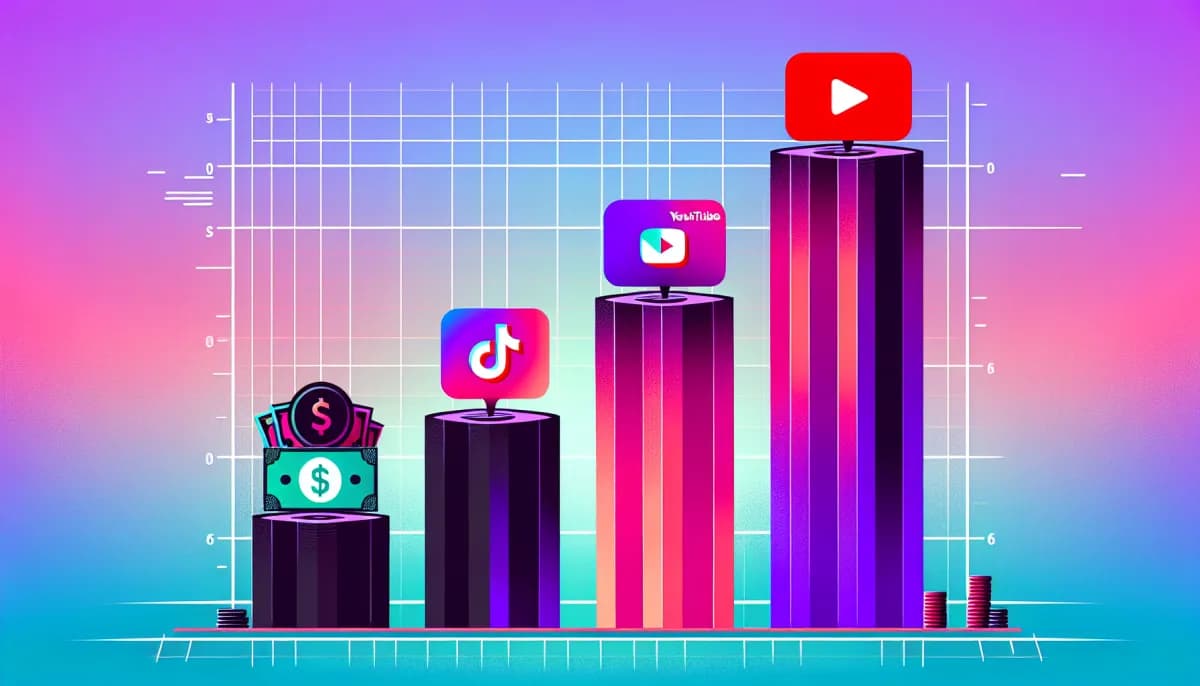
The difference between earning $1,000 or $100 on 1M views depends entirely on which platform you post to. That's not a hypothetical — it's the actual spread between what a US-based creator takes home from a million YouTube long-form views versus a million TikTok views in April 2026. And if you stretch the comparison to Instagram, the numbers get even more dramatic, because Instagram's platform payouts are effectively a rounding error next to what creators earn from sponsorships on the same content.
If you're a creator trying to figure out where to invest your time in 2026, or a brand trying to understand what creators actually earn on different platforms, or just someone curious about the real economics behind the creator economy, this is the guide you need. We're going to break down every major platform's revenue model, show you the real RPM ranges with sources, walk through eligibility requirements, and lay out the diversification playbook that every serious creator is running in 2026. No hype, no inflated averages, no "I made $10K on TikTok in a week" influencer marketing. Just the actual numbers.
Why creator pay comparison matters more than ever in 2026
Here's the thing about the creator economy in 2026: the platforms have become wildly different economic environments. Five years ago, if you were a creator, you picked your platform based on where your audience was and you made content. The monetization was secondary because nobody was making serious money directly from platform payouts anyway — everyone was living off brand deals. That's not true anymore. YouTube creators at scale are earning low-seven-figures annually from AdSense alone. TikTok has finally built a payout system that generates meaningful income. Instagram has Bonuses, Threads is rolling out ads, and LinkedIn just expanded BrandLink. The economics of where you post now directly determine how much you earn, even before you touch brand partnerships.
But here's the catch: the payout rates are wildly different, and the eligibility thresholds are wildly different, and the content formats that perform on each platform require completely different production approaches. A creator who thrives on YouTube long-form might produce content that would die on TikTok. A TikTok creator who's built a following on 30-second videos might struggle to justify a 20-minute YouTube video to their audience. Instagram rewards aesthetic consistency in ways that neither of the other platforms require. So "just post everywhere" isn't a strategy — it's a formula for mediocre content on all three platforms.
What you need instead is a clear-eyed understanding of what each platform pays, what it takes to unlock those payouts, and which platforms make sense for your specific content and audience. That's what we're going to build in this guide. Let's start with the gold standard.
YouTube: still the gold standard for long-form
There's no real debate in 2026 about which platform pays creators the most per view for long-form content: it's YouTube, and it's not particularly close. The YouTube Partner Program (YPP) remains the most mature, most transparent, and most lucrative direct monetization system in the creator economy. If you're producing content that can hold attention for 10+ minutes, YouTube is almost certainly where you should anchor your presence.
Let's talk actual numbers. YouTube's RPM — that's revenue per mille, or revenue per 1,000 views — sits in a range of roughly $1.50 to $6 for long-form content across most niches in 2026, based on data from Tubefilter's creator economy reports and Social Blade's aggregated channel data. Finance, tech, business, and real estate channels regularly pull RPMs of $8 to $9, which is why you see so many creators pivoting into those categories. Entertainment, vlogs, and general lifestyle content tends to sit on the lower end, around $1.50 to $3. Kids' content, after the COPPA changes, sits even lower because ads can't be personalized.
What this means in practice: Marques Brownlee's tech reviews, which regularly pull tens of millions of views, are generating RPMs probably in the $7 to $10 range because his audience is affluent and advertiser-friendly. A video with 20 million views on MKBHD's channel is realistically pulling $140,000 to $200,000 in YouTube ad revenue alone — and that's before you touch the multi-million-dollar sponsorship deals that videos of that scale attract. MrBeast, whose content is more entertainment-focused and therefore slightly lower on the RPM scale but who makes up for it with astronomical view counts (his biggest videos pull 400M+ views), is almost certainly generating $2-4 million per major video from AdSense alone. These are the economics that make YouTube the cornerstone of almost every successful creator business.
YouTube Shorts, however, is a completely different beast. Shorts RPMs sit at a dramatically lower $0.06 to $0.10 per 1,000 views — roughly 1/50th of what long-form commands. This is deliberate: YouTube designed the Shorts monetization pool to compensate creators from a shared fund rather than directly from ad inventory, because short-form video doesn't support the same ad density as long-form. The practical implication is that even a Short with 10 million views is likely generating $600 to $1,000 in direct revenue, whereas a long-form video with the same view count could generate $20,000 to $80,000.
YPP eligibility in 2026
The YouTube Partner Program still operates on two parallel eligibility tracks. The classic track requires 1,000 subscribers plus 4,000 public watch hours in the previous 12 months. The Shorts-focused track requires 1,000 subscribers plus 10 million Shorts views in the previous 90 days. Both tracks unlock the same monetization features once you're accepted, including the Shorts revenue-sharing pool and AdSense for long-form.
The lower entry tier (500 subscribers, 3,000 watch hours or 3M Shorts views) that YouTube introduced in 2023 still exists and gives access to tipping, Super Chat, and channel memberships, but not ad revenue. For most creators, the full YPP is the goal because that's where the serious money starts.
If you're trying to accelerate your path to YPP eligibility, building your YouTube subscriber base strategically can help you cross the 1,000-subscriber threshold faster and start generating social proof that drives organic growth. Just remember that watch hours are the harder metric — and those come from content that people actually want to watch for more than a few seconds.
TikTok Creator Rewards: the catch-up play
TikTok spent most of 2020 through 2023 paying creators almost nothing through its original Creator Fund — the infamous $0.02 to $0.04 per 1,000 views that became a meme among creator economists. That era is over. The Creator Rewards Program (which replaced the old Creator Fund in 2023 and has been iterated on since) now pays meaningfully better, though it's still behind YouTube long-form for per-view value.
The current numbers: Creator Rewards pays roughly $400 to $1,000 per 1 million qualified views in 2026, according to data from Influencer Marketing Hub, Modash, and various creator transparency reports. That works out to an RPM of roughly $0.40 to $1.00 — which means TikTok is now in the same ballpark as YouTube Shorts but still an order of magnitude below YouTube long-form. Finance and business content on TikTok can push the upper end to around $1.50 RPM, similar to the niche bonuses on YouTube.
The critical word in that calculation is "qualified." TikTok's Creator Rewards program has strict requirements for which views count toward your payout. Videos must be at least 1 minute long (TikTok dropped the original 60-second minimum in stages but the 1-minute threshold is what currently maximizes payout eligibility). Views must come from regions where Creator Rewards operates. Engagement signals matter — views from users who immediately bounce don't count the same as views from users who engage. And the content has to meet TikTok's originality and quality guidelines, which means repost content and overly-derivative formats get downgraded.
Charli D'Amelio, arguably TikTok's most famous creator, built her initial business almost entirely on brand deals and off-platform monetization because the original Creator Fund paid so little. Her current earnings model — which includes Creator Rewards, brand partnerships, her own cosmetics line, and a Hulu show — reflects the reality that TikTok creators still can't rely on platform payouts the way YouTube creators can. Even with the improved Creator Rewards rates, TikTok income is more of a supplement than a foundation for most creators at her scale.
For mid-tier creators, the math can still be attractive. A TikTok creator consistently pulling 5 to 10 million views per month on 1+ minute videos can generate $2,000 to $10,000 monthly from Creator Rewards alone — not life-changing, but meaningful, and a significant upgrade from where TikTok's direct monetization sat two years ago.
TikTok Creator Rewards eligibility
The eligibility thresholds for Creator Rewards are: 10,000 followers, 100,000 video views in the previous 30 days, and you must be at least 18 years old in a region where the program is available. Your account must be a Personal account (not a business account, though TikTok has been evolving this), and you must be in good standing with TikTok's community guidelines.
The 100,000 views in 30 days requirement is the one that trips up most creators. You can hit 10,000 followers without consistently strong recent performance, but the 30-day view threshold effectively requires that you're actively producing content that's getting traction. This is deliberate — TikTok doesn't want to pay out to dormant accounts or creators whose audiences have moved on.
Instagram: sponsorships over platform payouts
Instagram is the odd one out in this comparison, because its platform monetization story in 2026 is still fundamentally underwhelming compared to YouTube and TikTok. Meta has experimented with various direct creator payment systems over the past several years — the Reels Play Bonus program, various testing tiers, Breakthrough Bonuses — but none of them have produced the kind of consistent, reliable income that YouTube's AdSense or TikTok's Creator Rewards deliver at scale.
Here's the current state: Instagram Reels Bonuses, which remain invite-only in 2026, pay approximately $0.01 to $0.09 per 1,000 Reels plays. That's the lowest RPM range of any major platform's direct monetization program. Even at the upper end, a Reel with 10 million plays would generate $900 — and most bonused Reels generate significantly less because creators tend to hit the lower end of the range. And since the program is invite-only, most creators don't have access to even these modest payouts.
So if Instagram's platform payouts are essentially a rounding error, how do creators at scale make money on Instagram? The answer is sponsorships, and Instagram continues to be the most lucrative sponsorship platform in the creator economy. Emma Chamberlain, for example, has built a significant portion of her business on Instagram sponsorships — brands pay enormous premiums to reach her audience through her Reels and posts, often multiples of what equivalent deals would command on TikTok or YouTube. The CPM on an Instagram branded post for a creator with her audience profile can exceed $200, compared to direct Instagram platform payouts that max out around $0.09 per 1,000 plays.
"Instagram isn't where you get paid by the platform. Instagram is where you get paid by brands. Confuse those two things and you'll build the wrong content strategy. My Instagram Reels are, functionally, a showcase for potential sponsors — they're evidence of reach, engagement quality, and aesthetic consistency. The direct revenue from the platform is almost irrelevant to the business." — Creator economy analysis, Adweek, February 2026
This is why so many creators build differently on Instagram than on TikTok or YouTube. On Instagram, you're optimizing for sponsorship appeal: aesthetic consistency, audience demographics that brands want, engagement rates that prove your reach is real. On TikTok and YouTube, you can optimize more purely for reach because the platform itself is paying you meaningfully per view.
For most creators, this means Instagram should be part of a diversified strategy rather than a primary focus. You use Instagram to build a brandable audience and convert that audience into sponsorship revenue, while anchoring your per-view income on a platform that actually pays meaningfully per view. If you're building an Instagram presence to attract brand deals, strategically growing your Instagram follower count gives you the social proof that brands look for when evaluating potential partnerships.
2026 creator pay comparison table
Let's consolidate everything into a single comparison table. All figures are US-creator estimates based on April 2026 data, aggregated from the sources listed at the bottom of this post:
| Platform / Format | Typical RPM | Per 1M Views | Eligibility Threshold | Notes |
|---|---|---|---|---|
| YouTube long-form (finance/tech) | $7 to $9 | $7,000 to $9,000 | 1,000 subs + 4,000 watch hours | Highest-paying format in the creator economy |
| YouTube long-form (general) | $1.50 to $6 | $1,500 to $6,000 | 1,000 subs + 4,000 watch hours | Reliable baseline for most creators |
| YouTube Shorts | $0.06 to $0.10 | $60 to $100 | 1,000 subs + 10M Shorts views (90d) | Revenue-sharing pool model |
| TikTok Creator Rewards (1+ min) | $0.40 to $1.00 | $400 to $1,000 | 10K followers + 100K views (30d) | Must be 1+ minute; finance up to $1.50 RPM |
| Instagram Reels Bonuses | $0.01 to $0.09 | $10 to $90 | Invite-only in 2026 | Platform payouts are secondary; sponsorships dominate |
| Threads creator pool (rolling out) | TBD (piloting) | TBD | Invite-only pilot | $100-$200M global pool announced for 2026 |
| LinkedIn BrandLink | Variable (B2B CPMs) | High (B2B rates) | Follower/reach thresholds + content quality | B2B CPMs can exceed consumer-platform rates |
The takeaway from the table is stark: a million views on YouTube long-form in a finance niche is worth approximately 100x what the same million views generate on Instagram Reels Bonuses. This doesn't mean Instagram isn't valuable — but it does mean that "one million views" is a meaningless metric without the platform context, and creators who don't understand this spread end up making content strategy decisions that cost them dearly.
New entrants: Threads and LinkedIn BrandLink
Two platforms are making meaningful monetization moves in 2026 that every creator should have on their radar: Meta's Threads and LinkedIn's BrandLink.
Threads announced a global creator pool of $100 to $200 million for 2026, with ads rolling out to the platform starting in April 2026. This is Meta's attempt to turn what started as a Twitter-alternative into a genuine monetization ecosystem, and the early signs are that the pool is being distributed preferentially to creators who post original content with strong engagement signals — similar to how YouTube Shorts distributes its pool. The specific RPM hasn't been published yet because the program is still in pilot, but the math of a $150M pool distributed across Threads' active creator base suggests that early participants could see meaningful (if still modest) per-view income.
The strategic opportunity with Threads is that competition for the creator pool is currently low because the platform's monetization is still new. Creators who establish themselves on Threads in Q2 and Q3 2026 could capture a disproportionately large share of the initial pool before the platform's creator base scales up to match the payout infrastructure. This is the pattern that played out on TikTok in 2019-2020 and on YouTube in 2007-2010 — the early creators who got in before the monetization matured captured outsized returns.
LinkedIn BrandLink (formerly called Wire) has expanded significantly in 2026 for B2B creators. The program allows creators to place video ads adjacent to premium publisher content on LinkedIn, with revenue shared based on views and engagement. The RPMs on LinkedIn can be extraordinarily high because LinkedIn's audience — professionals with purchasing authority in B2B contexts — commands CPMs that consumer platforms can't match. A B2B creator with modest reach on LinkedIn can generate revenue that would require 10x the reach on TikTok or Instagram.
For creators whose content is genuinely professional in nature — business strategy, industry analysis, career development, B2B sales and marketing — LinkedIn BrandLink deserves serious consideration as a primary monetization platform, not just a secondary placement. The audience quality makes even smaller reach numbers financially significant.
Which platform for which creator profile?
With all of this in mind, here's how to think about which platform makes sense as your primary monetization anchor based on your content style and audience:
If you can produce 10+ minute videos: YouTube long-form is your primary home, full stop. The RPMs are too high and the audience investment too durable to build your monetization strategy around anything else. Even if you also post on TikTok and Instagram, YouTube should be where your best work lives and where you optimize hardest. Marques Brownlee's business is the template here — massive YouTube presence as the primary revenue driver, with other platforms as distribution amplifiers rather than monetization anchors.
If you're best at 1 to 5 minute short-form video: TikTok Creator Rewards plus YouTube Shorts is the strongest combination. You can cross-post much of your content with minimal modification, and you'll capture the TikTok rate on TikTok views and the Shorts rate on YouTube views. Neither is as lucrative as YouTube long-form per view, but the content production cadence allows for much higher total view volumes, which can make the math work.
If you're an aesthetic or lifestyle creator: Instagram is your brand showcase, but your direct monetization needs to come from sponsorships rather than platform payouts. Build your Instagram presence to attract brand deals, and use a secondary platform (likely TikTok for lifestyle content or YouTube for deeper content) to supplement with platform-direct revenue.
If you're B2B or professional content: LinkedIn deserves serious primary-platform consideration. The audience quality and BrandLink CPMs can generate more revenue per view than any consumer platform. Pair with YouTube long-form for the subset of your content that benefits from broader distribution.
If you're entertainment or comedy: TikTok is where you build initial reach, but the goal is to migrate or expand to YouTube Shorts (for the revenue share pool) and, ideally, to produce at least some long-form YouTube content that captures the higher RPMs. Pure TikTok entertainment strategies leave money on the table.
For creators at all of these scales, understanding what investment in your presence looks like across platforms is worth thinking through carefully. Our pricing page lays out what that looks like at different levels of growth so you can plan your investment strategically.
The takeaway: diversify or perish
The most important strategic lesson from all of this data is that no single platform is reliable enough to build a sustainable creator business around in 2026. Platforms change their monetization algorithms. Eligibility thresholds shift. Entire programs get shut down or restructured (RIP original TikTok Creator Fund). If your entire income depends on one platform's payout program, you're one policy change away from a catastrophic revenue drop.
The creators who are building durable businesses in 2026 are diversifying across three to four revenue sources: platform-direct payouts from at least two platforms (usually YouTube long-form plus one of TikTok/Shorts), sponsorships from Instagram or the same platforms, and often an owned-audience revenue source (newsletter, course, membership community, or direct product) that doesn't depend on any platform at all. MrBeast's business is the extreme example — YouTube AdSense is enormous, but so are his chocolate company, his burger restaurant, his philanthropic channels, and his branded products. No single revenue source represents a majority of his income.
You don't need MrBeast's scale to apply the same principle. Even a creator generating $50,000 annually should be thinking about diversification from day one, because the platform that's paying you best today might be the platform that quietly halves its RPM next quarter. The combination of a primary per-view revenue platform (YouTube long-form ideally), a secondary short-form platform (TikTok or Shorts), an Instagram presence for sponsorship deals, and at least one owned-audience channel is the playbook that separates durable creator businesses from cycles of platform-dependent boom-and-bust.
The creator economy in 2026 is more lucrative than it's ever been — YouTube alone has enabled a class of creators earning genuinely life-changing income — but it's also more complex. Understanding what each platform actually pays, who qualifies for those payouts, and how to build a content strategy that captures the best economics across multiple platforms is the difference between building a career and building a side hustle that might evaporate with the next algorithm change.
Sources
- Tubefilter — YouTube Creator RPM Analysis 2026
- Influencer Marketing Hub — TikTok Creator Rewards Program Breakdown
- Modash — TikTok Creator Fund & Creator Rewards Transparency Data
- Adweek — Instagram Reels Bonuses and the Creator Economy
- Meta Newsroom — Threads Monetization Rollout 2026
- LinkedIn Marketing Solutions — BrandLink Program Expansion 2026
- Social Blade — YouTube Channel Revenue Estimates
For real-world Instagram growth, see our dedicated Instagram services.